English
  Albanian

Abdominal pain is one of the most common complaints, but it should not always be treated as something simple or temporary. When pain starts around the navel and then moves to the lower right side of the abdomen, when accompanied by nausea, vomiting, fever, loss of appetite, or worsens with movement, it may be a sign of appendicitis. Appendicitis is inflammation of the appendix and often requires prompt medical evaluation, as if left undiagnosed and untreated in time, it can cause serious complications.
Çfarë është apendiciti?
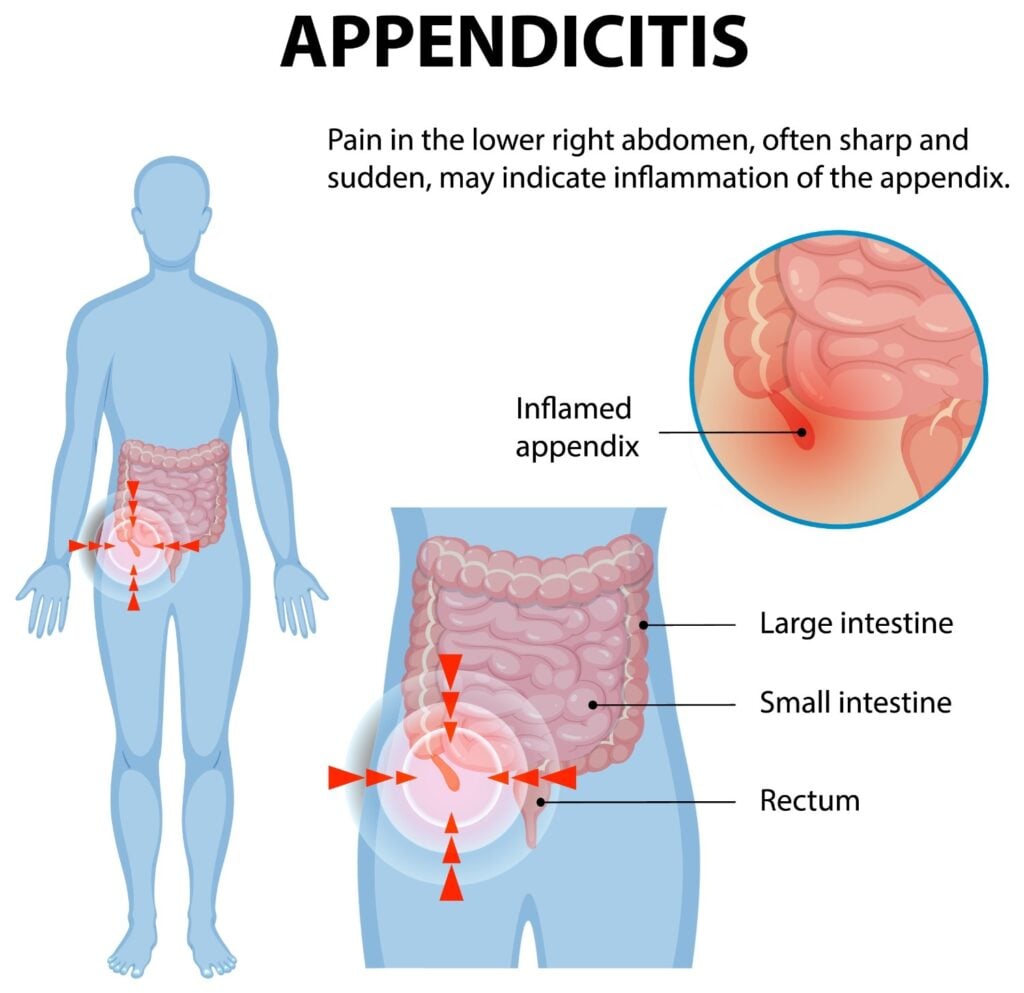
Appendicitis is the inflammation of the appendix, a small, tube-shaped structure located in the lower right abdomen, attached to the large intestine. Although the appendix does not have a vital function for the body, its inflammation can become a surgical emergency.
When the appendix becomes inflamed, it can swell, fill with pus, and cause severe pain. If the condition progresses and is not treated, the appendix can rupture. This can spread the infection into the abdominal cavity and cause a serious condition requiring urgent treatment.
For this reason, abdominal.
Appendicitis occurs when the appendix becomes inflamed.
Appendicitis usually occurs when the internal space of the appendix becomes blocked. This blockage can be caused by hard faecal matter, enlargement of lymphatic tissues, various infections, or other factors that obstruct the normal drainage of the appendix.
When the appendix becomes blocked, bacteria can multiply inside it and cause inflammation. Over time, the pressure inside the appendix increases, blood circulation to the area can be affected, and the risk of rupture increases.
Appendicitis can affect people of any age, but it is most common in older children, teenagers, and young adults. However, it can also occur in older adults, so any suspicious abdominal pain should be taken seriously.
Appendicitis pain usually starts around the belly button.
One of the most typical signs of appendicitis is how the pain starts and changes. Often, the pain begins in the area around the navel or in the upper part of the abdomen. Initially, it may be vague, mild, or similar to common stomach pains.
After a few hours, the pain may shift to the lower right side of the abdomen. This area becomes more tender and the pain may worsen when walking, coughing, moving, getting back into bed or touching the abdomen.
Not every patient presents in the same way. In some people, pain may be more diffuse, milder at first, or difficult to locate. This is especially true for children, the elderly, pregnant women, or patients with a different anatomical position of the appendix.
The most common symptoms of appendicitis
Besides abdominal pain, appendicitis can be accompanied by several other symptoms that help guide the diagnosis. Among the most common are nausea, vomiting, loss of appetite, a mild to moderate fever and a general feeling of weakness.
Some patients may experience abdominal bloating, constipation or diarrhoea. In other cases, difficulty passing gas or persistent abdominal discomfort may occur.
The signs that should prompt you to seek medical help are:
- abdominal pain that worsens with the passing of hours;
- pain in the lower right part of the abdomen;
- pain that increases when walking, coughing or moving;
- nausea and vomiting;
- loss of appetite;
- temperature;
- A feeling of weakness or general deterioration.
These symptoms don't always mean appendicitis, but they are sufficient reason to seek medical attention.

Why is appendicitis considered an emergency?
Appendicitis is considered an emergency because the inflammation can progress quickly. If the appendix ruptures, the infection can spread into the abdomen and cause more serious complications. This can make treatment more complex and recovery longer.
In the early stages, appendicitis is usually treated more easily and with less risk of complications. The longer medical assessment is delayed, the greater the risk that the inflammation will worsen.
For this reason, it is important not to wait for the pain to pass on its own, especially when it worsens, moves to the right side of the abdomen, or is accompanied by vomiting and fever.
What shouldn't you do if you suspect you have appendicitis?
When you have abdominal pain that could be related to appendicitis, it is not recommended to take strong painkillers without consulting a doctor, as they can mask the symptoms and make clinical evaluation more difficult.
Also, you should not use laxatives or medications to "cleanse" the intestines, because if the appendix is inflamed, these can worsen the condition. Applying heat to the abdomen is also not recommended, as it may have an adverse effect in cases of acute inflammation.
If the pain is severe, persistent or accompanied by other symptoms, the safest course of action is to seek a medical check-up.
How is appendicitis diagnosed?
Diagnosis of appendicitis begins with a medical consultation. The doctor assesses the history of symptoms, the location of the pain, how it started and how it has changed over time. During the physical examination, abdominal tenderness and signs that may indicate inflammation are checked.
To support the diagnosis, blood tests may be required, which help to assess signs of infection or inflammation. A urine analysis may be performed to rule out other problems, such as urinary tract infections or kidney stones, which can sometimes cause similar pain.
Imaging examinations, such as an abdominal ultrasound or a CT scan, can help confirm the diagnosis and assess the condition of the appendix. The choice of examination depends on the patient's age, symptoms, clinical condition, and the doctor's assessment.
Why is assessment by the surgeon important?
Appendicitis is a condition that often requires surgical evaluation. The surgeon assesses whether the symptoms, tests, and examinations indicate the need for surgical intervention or further observation.
In many cases, the standard treatment for acute appendicitis is the surgical removal of the appendix, known as an appendectomy. This can be performed using open or laparoscopic techniques, depending on the case, the patient's condition and the decision of the medical team.
Surgical rapid assessment is very important because it helps to reduce the risk of complications and to determine the safest treatment.
Can appendicitis be mistaken for other problems?
Yes. Appendicitis can be mistaken for several other conditions that cause abdominal pain. In women, lower abdominal pain can also be associated with gynaecological issues such as ovarian cysts, pelvic inflammation or pain related to the menstrual cycle.
In other patients, similar symptoms may be caused by urinary tract infections, kidney stones, bowel problems, gastroenteritis, colitis or other abdominal issues.
This is why diagnosis should not be based solely on the symptoms described by the patient. A medical examination, laboratory tests and imaging investigations are important for distinguishing appendicitis from other conditions and for avoiding delays in treatment.

Appendicitis in children
In children, appendicitis can be harder to diagnose, as they may not always be able to describe the location or nature of the pain accurately. A child might complain of stomach pain, refuse food, vomit, have a fever, or become more tired and less active than usual.
Parents should be vigilant when abdominal pain does not subside, worsens or is accompanied by other symptoms. In such cases, a medical examination is essential.
For children, delayed diagnosis can increase the risk of complications, so it's better to get a rapid assessment than to wait long at home.
Appendicitis in the elderly
In the elderly, appendicitis can present with milder or atypical symptoms. The pain may not be very severe initially and the temperature may not be high. This can make early diagnosis more difficult.
However, in the elderly, the risk of complications can be higher, especially when there are accompanying conditions such as diabetes, heart problems, or high blood pressure. Therefore, any unusual abdominal pain that lasts or worsens should be evaluated by a doctor.
Treatment of appendicitis
The treatment for appendicitis depends on the patient's condition, the stage of inflammation, and the presence or absence of complications. In many cases, the treatment is surgical and consists of the removal of the appendix.
An appendectomy can be performed using laparoscopic surgery, which involves small incisions and a camera to carry out the procedure, or through open surgery, in cases where this is more appropriate. The technique chosen depends on the patient's condition, the surgical team's experience, and the complexity of the case.
In certain specific situations, a doctor may recommend initial treatment with antibiotics or specific monitoring, but this is only decided after careful medical evaluation. Patients should not attempt to treat appendicitis themselves at home.
Recovery after surgery
Recovery after an appendectomy depends on the surgical technique, the condition of the appendix, the patient's age, and the presence of complications. In cases diagnosed and treated in a timely manner, recovery is usually faster.
After the intervention, the patient receives instructions on wound care, physical activity, nutrition, and follow-up. It is important to follow the doctor's advice and contact medical staff if fever, severe pain, wound redness, discharge, or a worsening of the general condition occur.
Why shouldn't you postpone your medical visit?
Many patients postpone their visit because they think that stomach pain might be due to food, gas, fatigue, or a temporary discomfort. In some cases this may be true, but when the pain has the characteristics of appendicitis, waiting can be dangerous.
If the pain moves to the right side of the abdomen, worsens with movement, is accompanied by vomiting, fever, or loss of appetite, it is safer to get it checked out.
Rapid diagnosis with surgical consultation, analysis, and imaging examinations helps determine the appropriate treatment and prevent complications.

Care at Family Hospital
At Family Hospital, patients receive careful medical assessment, accurate diagnosis, and treatment tailored to their condition.
The medical team assesses symptoms, performs the necessary examinations, and directs the patient towards the most appropriate treatment. The aim is for every patient to receive timely, professional, and safe care.
In cases where appendicitis requires surgical intervention, prompt assessment and follow-up by specialist doctors help in better management of the condition and in reducing the risk of complications.
When should you seek immediate medical attention?
Seek medical help urgently if you have worsening abdominal pain, particularly if it is located in the lower right side of your abdomen. Also, consult immediately if the pain is accompanied by nausea, vomiting, fever, loss of appetite, extreme weakness, or severe tenderness to touch.
If the pain is sudden, very severe or accompanied by a rapid deterioration in condition, it should be treated as an emergency.
Do not ignore abdominal pain if it is not similar to the common discomforts you have experienced before.
Frequently Asked Questions about appendicitis
Where is the pain of appendicitis usually felt?
The pain often starts around the navel and then moves to the lower right side of the abdomen. It can worsen with walking, coughing, or moving.
Këto janë simptomat kryesore të apendicitit: * Dhimbje barku që fillon afër kërthizës dhe pastaj lëviz drejt pjesës së poshtme të djathtë të barkut. Dhimbja zakonisht bëhet më e fortë dhe më e theksuar me kalimin e kohës. * Ndjeshmëri në pjesën e poshtme të djathtë të barkut, sidomos kur preket. * Humbja e oreksit. * Të përziera. * Të vjella. * Temperatura e ulët (ethe). * Ndryshime në zorrë, të tilla si kapsllëk ose diarre. * Duken të sëmurë. Simptomat mund të ndryshojnë nga personi në person. Për shembull, tek fëmijët e vegjël ose gratë shtatzënë, dhimbja mund të jetë në një vend tjetër. Nëse keni simptoma të apendicitit, duhet të kërkoni ndihmë mjekësore urgjente.
The most common symptoms are abdominal pain, nausea, vomiting, loss of appetite, fever, and abdominal tenderness to the touch.
Is appendicitis an emergency?
Appendicitis can worsen, and if the appendix ruptures, it can cause serious complications. For this reason, prompt medical evaluation is required.
Is appendicitis always treated with surgery?
In many cases, the standard treatment is the surgical removal of the appendix. However, the decision is made by the doctor after assessing the patient's condition and examination results.
Can I stay
If the pain worsens, moves to the right side of the abdomen, or is accompanied by vomiting, fever, and loss of appetite, you should not wait. You should seek medical attention as soon as possible.